
PT
The Direção-Geral da Administração da Justiça building, the service that runs Portugal's criminal record registry
Immigration 1 August 2026

A Portuguese criminal record certificate costs 5 euros online and lasts 90 days

A criminal record certificate in Portugal costs 5 euros online, is valid for 90 days, and there is a dedicated form for people living abroad. Costs, channels and timing explained.

It costs 5 euros, you request it online on the criminal record portal, and the document is valid for 90 days from the date it is issued. There — that is the answer most people are hunting for, so it goes first.

The rest of this guide covers the details that usually wreck an application: when you actually need one, what to do if you have no Chave Móvel Digital, what changes if you live abroad, and why the Portuguese certificate almost never travels alone.

What is the criminal record certificate for?

It is the document stating what does (or does not) appear on your criminal record in Portugal. It shows up in nearly every serious administrative process: Portuguese citizenship applications, some residence procedures, public sector competitions, applications to regulated professions, licences and hiring in certain sectors.

Here is the bit that trips people up: the certificate is issued against a purpose that you declare when applying. It is not a generic document that works for everything. You state what it is for — citizenship, taking up a role, a specific competition — and the certificate is issued with that purpose printed on it. If you later need one for something else, the safe move is to request another. It costs 5 euros; it is not worth risking a refusal.

How much does it cost and how long does it take?

Online it is 5 euros. Requested by post with international delivery, it rises to 8.25 euros including postage. The electronic request is the standard and fastest route: you log in to the portal, authenticate, state the purpose, pay, and the certificate is issued digitally with a code that lets whoever receives it verify authenticity online.

Validity is 90 days from issue. That deadline is the classic trap: people pull the certificate at the start of a long process, the process drags, and by the time they finally hand in the file the document has expired. The practical rule is simple — the criminal record should be one of the last documents you request, not one of the first.

How do you request it online?

Through the Ministry of Justice criminal record portal or the public services portal. Authentication uses a Cartão de Cidadão (with PIN and card reader) or the Chave Móvel Digital, which is the more comfortable route because it only needs your phone.

And if you have neither? There is a specific online form for people resident abroad — Portuguese or foreign — who hold neither a Cartão de Cidadão with PIN and reader nor a Chave Móvel Digital. It exists precisely to solve the case of someone outside the country who cannot authenticate the usual way.

In person, there is also the consular network. Several Espaços do Cidadão inside consulates provide this service, including Berlin, Boston, Brussels, Geneva, London, Luanda, Luxembourg, Madrid, Paris, Rio de Janeiro, São Paulo, Toronto and Zurich.

What about the criminal record from your home country?

This is the part that catches half of everyone out. The Portuguese certificate only covers what happened in Portugal. In a citizenship process, for instance, the authority will normally also ask for a criminal record from your country of origin and from countries where you have lived — and that foreign document has to be legalised to count here.

That is where the Hague apostille comes in, costing 10.20 euros and turning a foreign-issued document into one Portugal recognises. Without that legalisation (or consular legalisation, for countries outside the Convention), the foreign certificate is just an attractive sheet of paper. Start it early, because issuing times vary wildly between countries and are entirely outside your control.

Quick questions

How much does a Portuguese criminal record certificate cost?

5 euros for the online request. By post with international delivery it is 8.25 euros, postage included.

How long is a Portuguese criminal record valid?

90 days from the date of issue. Request it close to when you will hand it in, not at the start of the process.

Can I request it if I live outside Portugal?

Yes. There is a dedicated online form for residents abroad without a Cartão de Cidadão with PIN and reader or a Chave Móvel Digital, and several consulates provide the service in person.

Do I need a criminal record for Portuguese citizenship?

Yes, and the Portuguese one usually is not enough on its own: the one from your country of origin is typically required too, properly legalised. Check the exact document list before you start, because it shifted with the revised citizenship requirements, including the language test and the civics test.

Where do you apply?

On the Ministry of Justice criminal record portal or the state public services portal, authenticating with a Cartão de Cidadão or Chave Móvel Digital.

By Juliana Castilho

Image: Threeohsix / Wikimedia Commons (CC BY-SA 4.0)

A Loja do Cidadão citizen shop, home to AIMA service desks
Immigration 28 September 2026

AIMA tracker: deadlines, backlog and updates

A running tracker of AIMA — case backlog, renewal deadlines, biometrics, golden visa and service changes. Updated whenever there is news.

If you are dealing with residence or nationality, this is the page to bookmark. Instead of one article per announcement, we gather the essentials of AIMA here: case backlog, renewal deadlines, biometrics, golden visa and service changes. For the citizenship rules, see the new nationality law. Official information is at AIMA. EU citizens and their family members can now open an account on AIMA's Renewal Portal and handle the renewal online: application,…

Continue reading
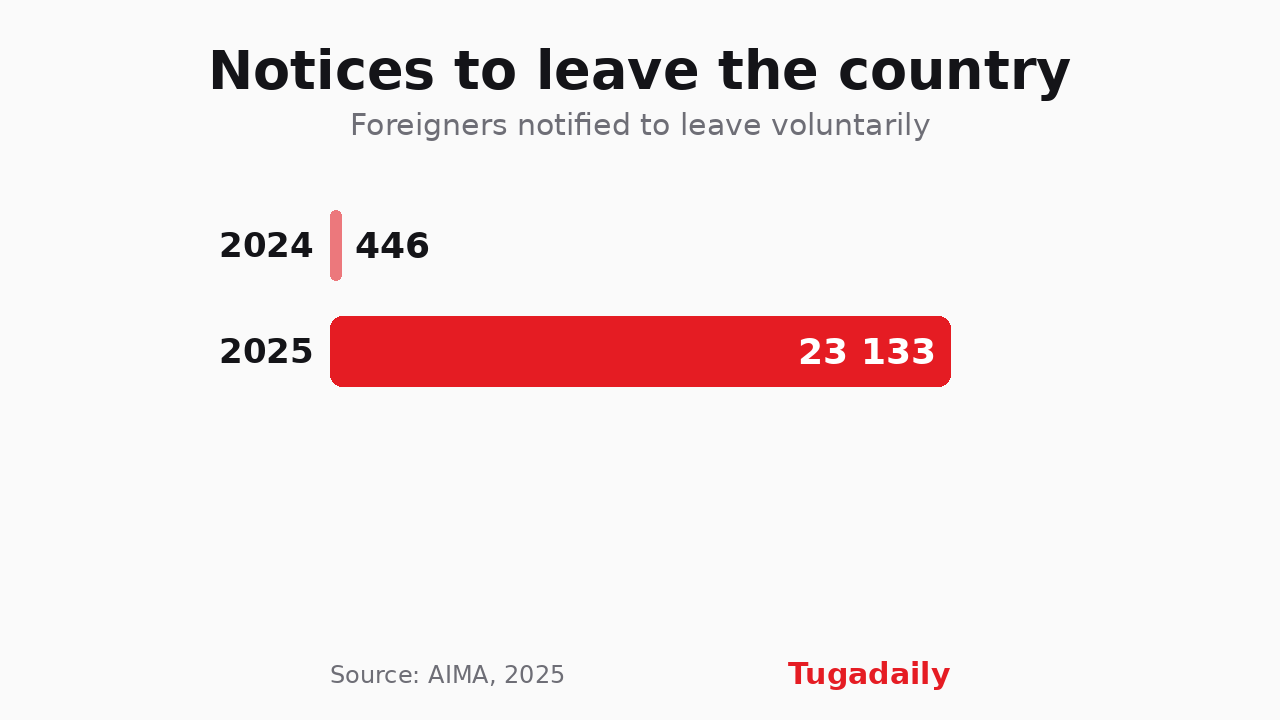
Tugadaily chart: notices for foreigners to leave voluntarily, 446 in 2024 versus 23,133 in 2025
Immigration 25 September 2026

Portugal told 23,133 foreigners to leave last year. In 2024, that number was 446

AIMA's 2025 Migration and Asylum Report shows voluntary-departure notices jumping 52-fold in a single year, in the same report that shows foreign-population growth slowing to 2.7%.

In 2024, Portugal's immigration agency AIMA and the police issued 446 notices telling foreigners to leave the country voluntarily. In 2025, that number jumped to 23,133 — more than 50 times as many, according to AIMA's 2025 Migration and Asylum Report, which pulls together the year's full numbers for the first time. The jump sits in the same report we already used to show that Portugal's foreign resident population grew just 2.7% in 2025, down from 39%…

Continue reading
The facade of the São Bento Palace, seat of Portugal's Parliament, in Lisbon
Immigration 23 September 2026

AIMA is losing its president again, and no successor has been named

Pedro Portugal Gaspar was called before Parliament this week for a seat on Portugal's Competition Authority board. He is the second AIMA president to leave since the agency replaced SEF in 2023, and the government has not said who comes next.

Pedro Portugal Gaspar is on his way out as president of AIMA, the agency that handles immigration and residency in Portugal. He was due before Parliament's Economy and Territorial Cohesion Committee on Tuesday, 22 September — the hearing that comes before a formal appointment to the board of the Competition Authority. Gaspar took over AIMA in July 2024 from Luís Goes Pinheiro, the agency's first president, who had led it since it replaced the old…

Continue reading
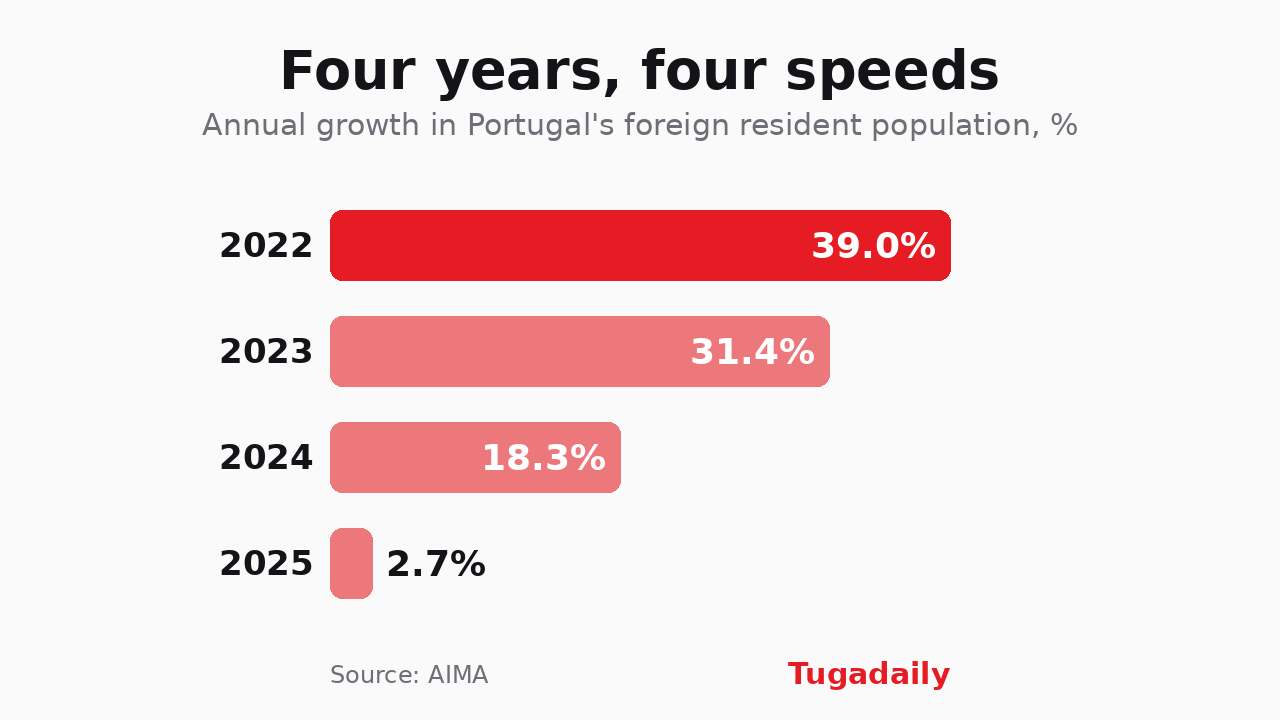
Bar chart of annual growth in Portugal's foreign resident population: 39.0% in 2022, 31.4% in 2023, 18.3% in 2024 and 2.7% in 2025
Immigration 22 September 2026

Portugal's foreign population grew 2.7% last year. In 2022 it grew 39%

AIMA's annual report closes 2025 with 1,585,854 foreign residents and 42,157 added over the year, against 238,864 in 2024. It is the slowest rate in the whole series the agency publishes, which starts in 2017, and the ranking shifted too: Angola has moved ahead of India.

There is a way of reading AIMA's annual report that skips the headline total and tells you far more. Put four years next to each other. In 2022, Portugal's foreign resident population grew by 39%. In 2023, by 31.4%. In 2024, by 18.3%. In 2025, by 2.7%. That is the slowest annual growth anywhere in the series the agency publishes, which begins in 2017. At the end of last year there were 1,585,854 foreign citizens legally resident in the country. Over the…

Continue reading
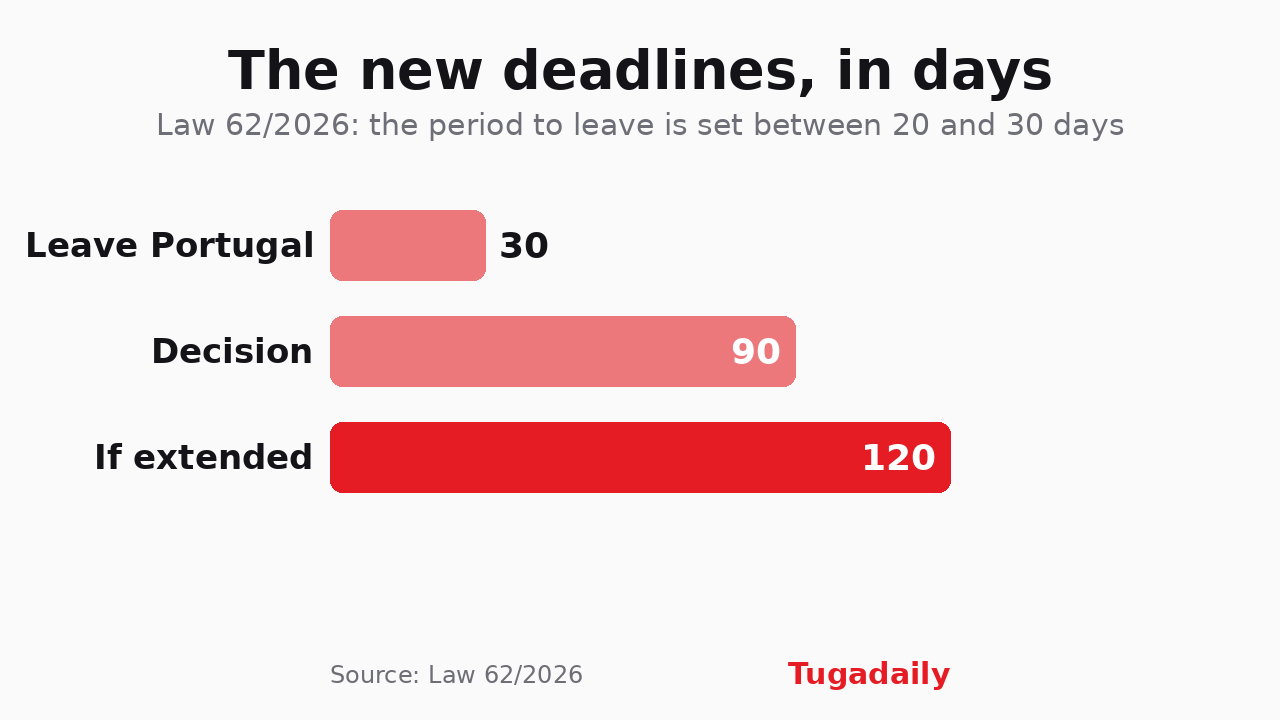
Bar chart of the deadlines in Portugal's Law 62/2026, in days: leave Portugal up to 30, in a period set between 20 and 30, decision 90, if extended 120
Immigration 15 September 2026

Portugal's new foreigners and asylum law took effect on 11 September

Law 62/2026 was published in the official gazette on 10 September and applied from the next day. It resets removal deadlines, creates a border return procedure and closes the vocational-course route to a residence permit.

For seven weeks the text sat in the president's in-tray and then in the Constitutional Court, and nothing on the ground changed. That is over. Law 62/2026 was published in the Diário da República on 10 September, and because the law says it takes effect the day after publication, it has applied since Friday 11 September. Parliament passed the decree on 17 July, the president signed it on 31 August, the prime minister countersigned on 1 September, and…

Continue reading
Passengers with luggage beside a coach on the platforms of the Sete Rios bus terminal in Lisbon
Immigration 14 September 2026

Arriving in Lisbon by coach or train? Portuguese police are running border checks at the terminals

The PSP's foreigners and borders unit says irregular arrivals by road and rail into the Lisbon and Porto metropolitan areas are rising, coming in from other European cities. For travellers, the practical bit is simple: carry your residence permit.

The route has shifted, and that is what the PSP came out to say on Sunday. Chief superintendent João Ribeiro, deputy national director and head of the National Foreigners and Borders Unit, named road and rail flows into the Lisbon and Porto metropolitan areas from other European cities as an identified risk factor — people who are irregular in another Schengen country and who keep moving between countries inside it. They arrive, he said, at the big coach…

Continue reading
The cloister of the Colégio do Espírito Santo at the University of Évora, with white arcades around a central fountain
Immigration 12 September 2026

Where do Évora's 650 international students file their residence papers now? On campus

The University of Évora and AIMA have opened a CLAIM office in the Santo Agostinho building, staffed by two people trained to file cases directly in the agency's system. Biometrics are still collected in Lisbon.

Studying in Évora on a non-EU passport used to mean solving the first step of your residence process 130 kilometres away. Not any more. On Wednesday the University of Évora and AIMA opened a CLAIM office — the local migrant integration support centre — in the Santo Agostinho building, and it began operating the same day. Two university staff run it, trained by AIMA to work directly inside the agency's case system. This is not an information desk. Cases…

Continue reading
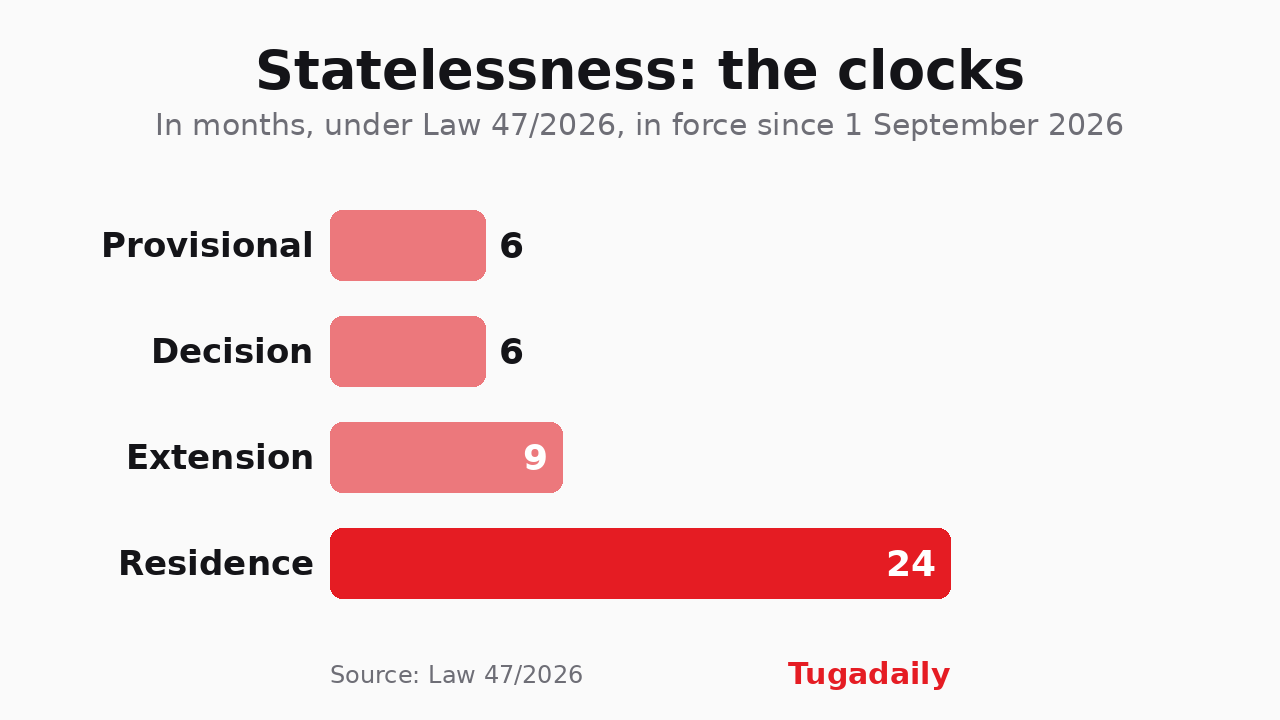
Bar chart of the deadlines in Law 47/2026, in months: a six-month provisional permit, six months to decide, nine in complex cases and a 24-month residence permit if the status is recognised
Immigration 6 September 2026

No country claims you as a citizen? Since 1 September there is a procedure, and it is free

Law 47/2026 came into force on 1 September and hands AIMA the job of recognising stateless status. Opening a case gets you a provisional residence permit for six months, and the right to work, on day one.

Portugal has recognised stateless status since 2023. What it did not have was a route to it: no authority formally in charge, no deadline, no document to hand to someone left waiting. That changed on 1 September, when Law 47/2026 of 17 August came into force and set out the procedure across seven pages. We read all seven. A stateless person, for the purposes of the law, is anyone no state considers its national. The application goes to AIMA's head office…

Continue reading
Aerial view of Lagos marina in the Algarve, with moored boats and the town around it
Immigration 4 September 2026

The Algarve came second in the world's retirement rankings (and the winner is in Panama)

Live and Invest Overseas put the Algarve ahead of Crete, Gascony, Puerto Vallarta and Tarragona in its 2026 index — and puts the cost for a couple at around $3,085 a month.

There is an American list that comes out every year and quietly moves people between continents. It is the Overseas Retirement Index, published by Live and Invest Overseas, and in the 2026 edition the Algarve placed second among the best places in the world to retire. Only Boquete, a town in the Panamanian highlands, finished ahead of it. What the Algarve beat is more interesting than the placing. It finished above Puerto Vallarta in Mexico, Gascony in…

Continue reading
The pink facade of the Belem Palace in Lisbon seen from the gardens in front, with the Portuguese flag flying to the left
Immigration 3 September 2026

Portugal's return law was signed on 31 August. What happens next turns on a 160-page ruling

President Seguro promulgated the decree overhauling reception, entry, removal and asylum rules three days after the Constitutional Court cleared it. The court also set out how the text must be read, and that reading now guides judges and officials.

It is signed. António José Seguro put his name to the decree on 31 August, the one that rewrites how foreign nationals and stateless people are received in temporary detention centres, how they enter, stay, leave or are removed from the country, and how asylum is granted. Three days passed between the Constitutional Court's ruling and the signature.

Continue reading
The Palacio Ratton in Lisbon, seat of Portugal's Constitutional Court, shot from below with the national flag flying and a red carnation blurred in the foreground
Immigration 30 August 2026

Portugal's return law clears the Constitutional Court, all eleven questions rejected

The seven judges who signed the ruling were unanimous: not one of the eleven provisions is unconstitutional. The President had sent the decree up on 7 August, and every objection fell.

Portugal's Constitutional Court ruled on Friday that there is nothing unconstitutional in the law on asylum, detention and the return of foreign nationals. Not one of the eleven provisions put in front of it. The seven judges who signed ruling 736/2026 were unanimous. The answer is quick to state and slow to read: the ruling runs to more than 160 pages, according to the court's president, João Carlos Loureiro.

Continue reading
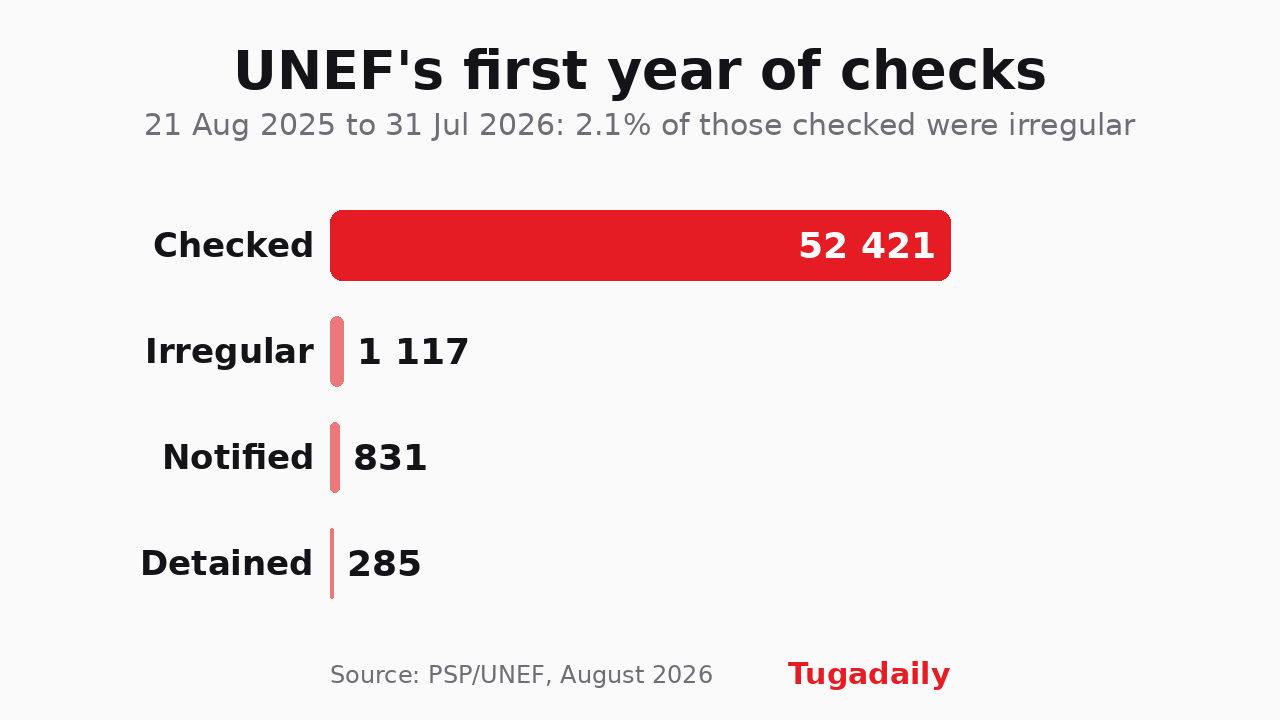
Bar chart of the UNEF's first year of checks: 52,421 foreign citizens checked, 1,117 irregular, 831 notified and 285 detained
Immigration 27 August 2026

Portugal's new border unit checked 52,421 foreigners. Just 2.1% were irregular

The PSP has released first-year figures for the UNEF: 5,397 operations between 21 August 2025 and 31 July 2026, 831 notices to leave the country and 285 arrests. Here is what that 2.1% can and cannot tell you.

Portugal's police have totted up the first year of the National Unit for Foreigners and Borders. The figure worth pausing on is not the arrests. It is the ratio. Between 21 August 2025 and 31 July 2026, the unit's foreigners and border control teams ran 5,397 inspection operations and checked 52,421 foreign citizens. Of those, 1,117 turned out to be irregular. That is 2.1%. The same operations produced 831 notices to leave the country voluntarily, 285…

Continue reading
The Loja do Cidadão public service building in Santiago do Cacém, signage above the entrance
Immigration 26 August 2026

What AIMA accepts as proof of address when your name is not on the lease

Renting a room, or living in a flat leased by someone else, means the document AIMA wants has another person's name on it. There is a route for that: a sworn declaration carrying the land-registry number and the owner's NIF, plus a tax-domicile certificate issued in the last 30 days.

One detail catches people out at an AIMA appointment, and it is not the queue. It is proof of accommodation. If you own the flat, the whole thing takes a minute. If you rent a room in a shared house, live with a relative, or hold a tenancy signed by somebody else, you have a genuine problem: the document AIMA wants to see has another person's name across the top of it. The good news is that a route exists for precisely that situation. The bad news is that…

Continue reading
Service desks at an Espaço do Cidadão government office in Portugal, with staff at the counters and people seated waiting their turn
Immigration 25 August 2026

Bringing a child to Portugal through family reunification? They have to be here on the day you file

A little-known condition on AIMA's Family Reunification of Minors platform catches a lot of families out: the child must be demonstrably on Portuguese territory on the date the application is submitted. If they are still abroad, the portal will not take it and the application has to be made in person.

If you are in Portugal and want to bring a child over through family reunification, there is a little-known condition that undoes a lot of people's planning: the child has to be demonstrably on Portuguese territory on the date the application is filed through the Family Reunification of Minors platform. It is set out in AIMA's own information note on family reunification and repeated on the Foreign Ministry's list of AIMA booking platforms, which spells…

Continue reading