
Portugal's 37th Storm Kristin law was published on Tuesday
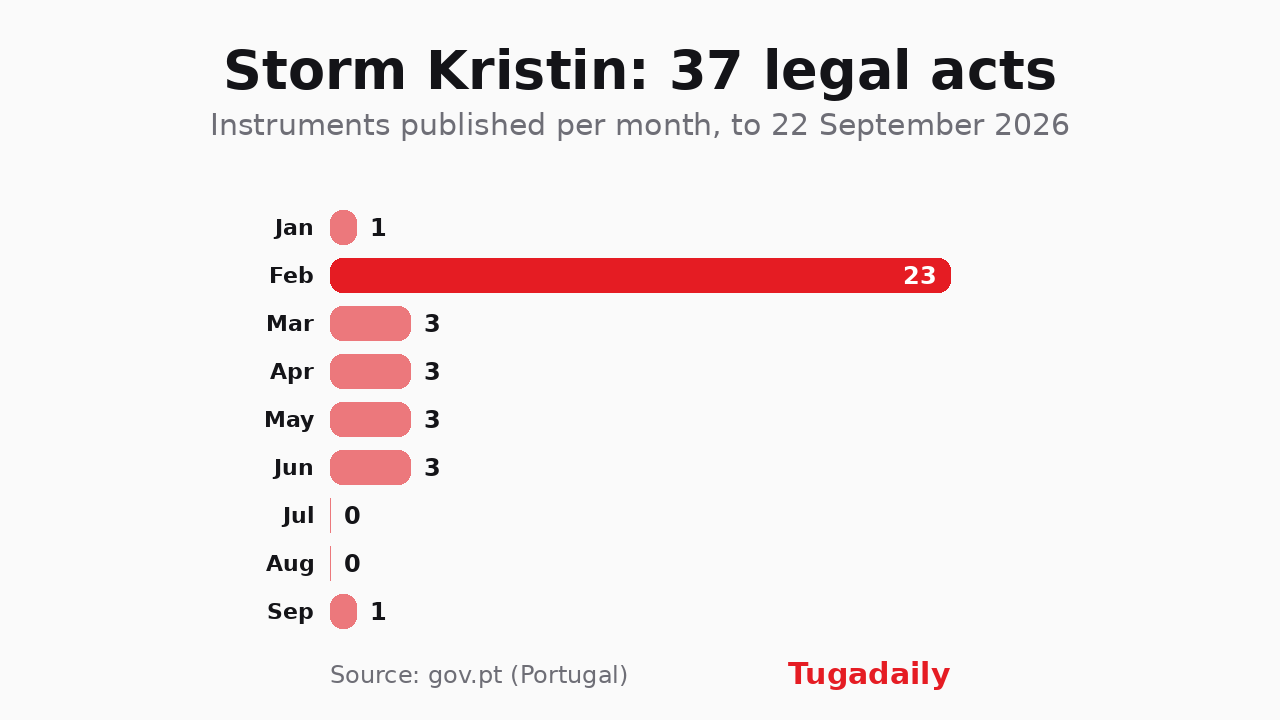
We counted the calamity legislation list the Government itself keeps on gov.pt: 37 instruments since 30 January, 24 of them in the first four weeks, none at all in July or August. The newest one rewrites the overtime rules for the people who answered the storm.
Storm Kristin crossed Portugal in the last week of January. The state of calamity lasted nineteen days. The legislation has not stopped.
Decreto-Lei n.º 191/2026 appeared in the Diário da República on Tuesday, and we wanted to know where it sat in the queue. So we counted. The Government keeps a guide listing every piece of calamity legislation on gov.pt, updated as each one lands. We added up the entries on that page, one by one, with the date on each. The answer is 37, running from the resolution that declared the calamity on 30 January to Tuesday’s decree.
Twenty-four of them came in the first four weeks
The distribution says more than the total does. Between 30 January and 26 February the state issued 24 of the 37, close to two thirds of everything Kristin has generated in law, at a pace of roughly one new instrument every other day. After that it settles to three a month from March through June. July and August produced nothing. September has this one, on its own.
None of it is ceremonial. Credit moratoriums, housing grants, working-capital credit lines, toll exemptions, a temporary accommodation scheme, emergency procurement rules, mission structures. Each changed something concrete for somebody who lost a roof or a road.
What number 37 does, and what it leaves open
Tuesday’s decree is the second amendment to Decreto-Lei n.º 40-A/2026, the emergency regime that simplified the administration and financing of reconstruction. It touches two articles.
The substantive one widens article 25. Overtime worked in the response to the calamity counts as force majeure, and so falls outside the limits set by the public-service employment law and the Labour Code. That already applied to central government staff. It now covers local authority workers too, and staff of state-owned and municipally-owned companies. Anyone who pulled shifts for a câmara municipal, or for a municipal water company, had been outside the regime until this week. The new wording also backdates the effects to the day the calamity was declared, picking up the two and a half weeks between 28 January and 14 February that the preamble concedes had been left out.
The closing date is unchanged: 30 June 2026. Which is where it gets odd. A decree that takes effect on 23 September governs hours worked in a window that shut 85 days earlier.
In August we wrote that the published text was still missing, and that it would be the thing to tell us which pay uplifts apply and how the accounts get settled for people already paid on another basis. The text has arrived and it answers neither. Two amended articles and a commencement clause, and that is all of it. The portaria setting the amounts is still outstanding, so the advice holds: keep your attendance records.
For the record, the calendar: approved in Council of Ministers on 20 August, signed into law by the President on 15 September, countersigned on the 16th, published on the 22nd. Thirty-three days from approval to the Diário da República.
The Government’s own page notes at the bottom that it is under constant revision. On Tuesday’s count, it has further to run.
Chart: Tugadaily, from the calamity legislation list published by the Portuguese Government on gov.pt