
PT
Aerial view of rooftop cooling units on a large data centre
Tech 30 July 2026

Europe's AI gigafactories are open for bids, and Portugal is in the race with Sines

The European Commission has formally launched the call for seven AI gigafactories, with roughly 30 billion euros in play. Portugal is co-funding it and backing an Iberian bid anchored in Sines.

After months of talking about it, Europe has finally put the thing on paper. The European Commission has formally opened the call to build seven artificial intelligence gigafactories across the continent, an operation expected to mobilise something in the region of 30 billion euros. And Portugal is not watching this one from the stands.

What is an AI gigafactory?

It is Europe’s answer to the muscle problem. These are industrial-scale computing sites, tens of thousands of specialised chips working in concert, designed to train AI models rather than merely run them. It is the piece Europe does not have, and without it European companies keep renting capacity from American and Chinese providers. The official programme details sit with the Commission’s digital strategy.

How does the call work?

It is split into two lots, each with two phases, and co-financed by 18 member states, Portugal among them. The staged design is deliberate: first you filter out the unserious bids, then you get into the detail of how much private money each consortium can actually bring. The 30 billion figure is not a cheque from Brussels, it is the total investment the scheme hopes to unlock from public and private sources combined.

Where does Portugal fit in?

In an Iberian bid put together with Spain, which foresees the infrastructure split roughly down the middle between the two countries. On the Portuguese side, the chosen location is Sines, which will surprise nobody following the file: that is where the subsea cable lands, and where the land, the power and the Atlantic connection already are. In June the government approved 200 million euros to strengthen the bid.

None of this appeared out of nowhere. It slots into the 400 million euro plan Portugal built for artificial intelligence and the decision to spread new data centre industrial zones around the country instead of piling everything around Lisbon.

Then comes the hard part, which is winning. Seven gigafactories for an entire continent means a long queue, with countries arriving with deeper pockets and denser ecosystems. The Iberian advantage is simultaneously the dullest and the most decisive one available: cheap, plentiful renewable power, which is precisely what these machines are hungriest for.

By Oliver Grant

Image: Rsparks3 / Wikimedia Commons (CC0)

Three engineers leaning over a laptop next to an industrial robotic arm in a workshop
Tech 26 September 2026

Portugal wants to teach AI to 100,000 SME workers. It starts in October, at a mould factory in Marinha Grande

The first pilot launches in October in the Leiria region, with around 100 workers, while a second tests AI inside five or six mould-making factories in Marinha Grande. The national target is 100,000 SME workers, backed by over €400 million already paid out through IFIC and another €800 million reprogrammed from the PRR recovery fund.

Portugal already had a €400 million plan for artificial intelligence, announced back in June. What it lacked was a date and an address. Now it has both. The Minister of Economy and Territorial Cohesion, Manuel Castro Almeida, told Parliament the goal is to train 100,000 workers at small and medium-sized businesses in artificial intelligence — and that the first pilot launches as soon as October, in the Leiria region, with around 100 workers from various…

Continue reading
A Tekever StormShroud drone, marked with Royal Air Force insignia, mounted on its transport case before launch
Tech 25 September 2026

TEKEVER is now worth $6.4 billion, after raising another $580 million

The Series D is led by UC Investments, making its first direct investment in Europe, and Baillie Gifford. In August the talk was of about €500 million at a €5.5 billion valuation; it closed at almost exactly those terms.

TEKEVER, the autonomous-systems company founded in Portugal, has closed the first tranche of a $580 million Series D round, valuing the business at $6.4 billion. The company confirmed the figures itself, with UC Investments (the University of California's fund, making its first direct investment in Europe) and Scottish investment manager Baillie Gifford leading the round.

Continue reading
Official Lisbon AI Week poster, with the dates 21 to 27 September 2026
Tech 24 September 2026

Half of Observador's visits used to come from Google. That traffic is now shrinking

At Lisbon AI Week, Observador general director Rudolf Gruner said roughly half the paper's visits came through Google tools, and that share is falling as AI answers people directly. The homepage, over 60% of page views in 2014, is now under 20%.

Lisbon AI Week is running across the city through Sunday, with dozens of events from hackathons to debates on creativity, health and security. At one of them, on AI and the media, a newspaper boss did something AI panels rarely do: he put his own numbers on the table. Rudolf Gruner, general director of Observador, said roughly half of the paper's visits used to arrive through Google's tools (Search, Discover and Google News). That traffic is now falling.…

Continue reading
The DATA4 data centre campus in Alcobendas, in the Madrid metropolitan area, seen from the street, with white buildings and security gates
Tech 22 September 2026

Spain has handed data centres about 12 GW of grid access. Its own 2030 plan asked for four

A draft royal decree would force data centres to cover 80% of every hour's electricity with newly built renewables. The industry puts nine billion euros at risk and names Portugal as the alternative. The reason for the clampdown is in the decree's own preamble.

The short version doing the rounds this week is easy enough: Spain tightened the rules on data centres, and the industry is threatening to move to Portugal. The long version is sitting in the document nobody opened, and it is considerably more interesting. Spain's ecological transition ministry has put out for public hearing a draft royal decree setting energy, environmental and digital sovereignty requirements on any installation above 1 MW. The…

Continue reading
An open Pixel 11 Pro Fold showing American Sign Language being translated into text on screen, with the ASL label above the translated sentence
Tech 20 September 2026

Which sign language does the Pixel 11 read? American, and only American

Google's sign-to-text feature turns ASL into written English. Portuguese Sign Language is not part of it, and a month after the Portuguese launch there is still no per-feature language list for the rest of Gemini.

When the Pixel 11 reached Portuguese shops in August, one question went unanswered: does the artificial intelligence that fills the whole presentation actually work in Portuguese? For one feature there is now an answer, and it is narrower than the launch suggested. Sign-to-text, sold as one of the range's headline accessibility wins, reads American Sign Language and writes English. This is not a market rollout waiting on a switch somewhere. It is how the…

Continue reading
Opening artwork from Hacktron AI's research post titled Hacking OpenAI
Tech 19 September 2026

The people who broke into OpenAI's internal code spent less than 3,000 dollars doing it

OpenAI closed the hole fourteen hours after it was reported and paid a 6,500 dollar bounty. The figure that matters to anyone running a website is the cost: a two-month campaign that also probed Slack and Meta ran on under 3,000 dollars of tokens.

The version of this story that travelled was the catchy one: a team used one AI lab's model to get inside another AI lab. That is documented and true. The detail worth your attention if you run a website sits halfway down the report instead. Start with what happened. On 25 July, three researchers at a security startup called Hacktron AI reached OpenAI staff accounts and, through them, an internal code repository. To prove the access without reading…

Continue reading
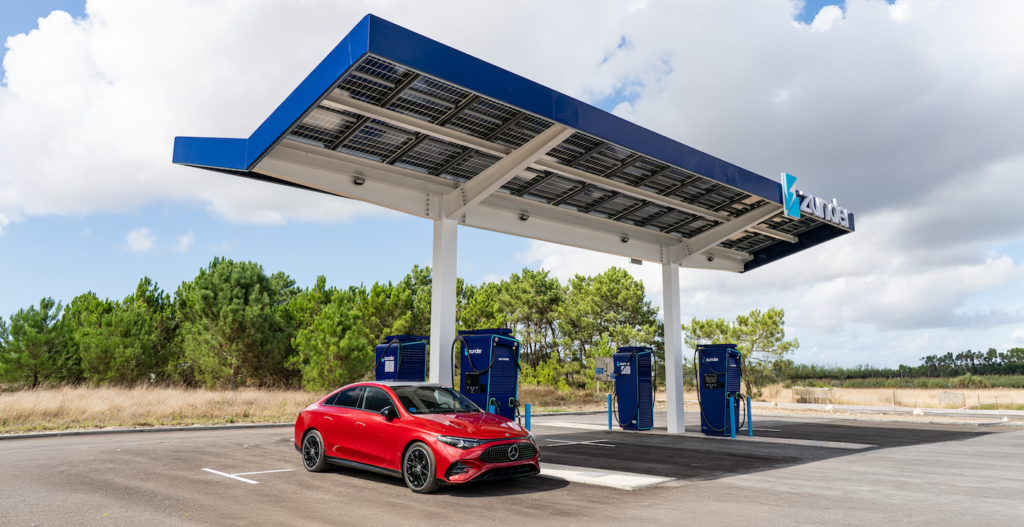
Zunder's ultra-fast charging station beside the A8 at Caldas da Rainha, with a photovoltaic canopy over the chargers
Tech 18 September 2026

12 fast chargers just opened on the A8, and 2 of them fit a lorry

Zunder's station at junction 19, outside Caldas da Rainha, went live on 11 September with 400 kW CCS points and a solar canopy. The bays sized for heavy vehicles are the first public ones in Portugal.

If you drive an electric car between Lisbon and Porto, range has quietly stopped being a conversation. If you drive an electric lorry, it is most of the conversation, because until this month there was nowhere public in Portugal to stop halfway and put charge back into a heavy vehicle. The station the Spanish operator Zunder opened on 11 September at Caldas da Rainha is the first answer to that, on a modest scale. It sits at junction 19 of the A8, beside…

Continue reading
A Vega-C rocket lifting off at night from Kourou in French Guiana carrying the FLEX and Sentinel-3C satellites
Tech 17 September 2026

ESA's new FLEX satellite measures photosynthesis from 814 kilometres up

It went up on a Vega-C from Kourou on 15 September, the first satellite built specifically to measure photosynthesis. It flies at 814km, has three and a half years of life and revisits the same spot every 27 days.

A struggling plant does not change colour on the day it starts struggling. It slows down internally first, and the leaf gives the game away weeks later. Catching that earlier stage is the whole reason the European Space Agency put a satellite up this week. It is called FLEX, and it launched on 15 September aboard a Vega-C from Kourou in French Guiana, on flight VV30. It had company. Copernicus Sentinel-3C rode the same rocket, sitting on top of the launch…

Continue reading
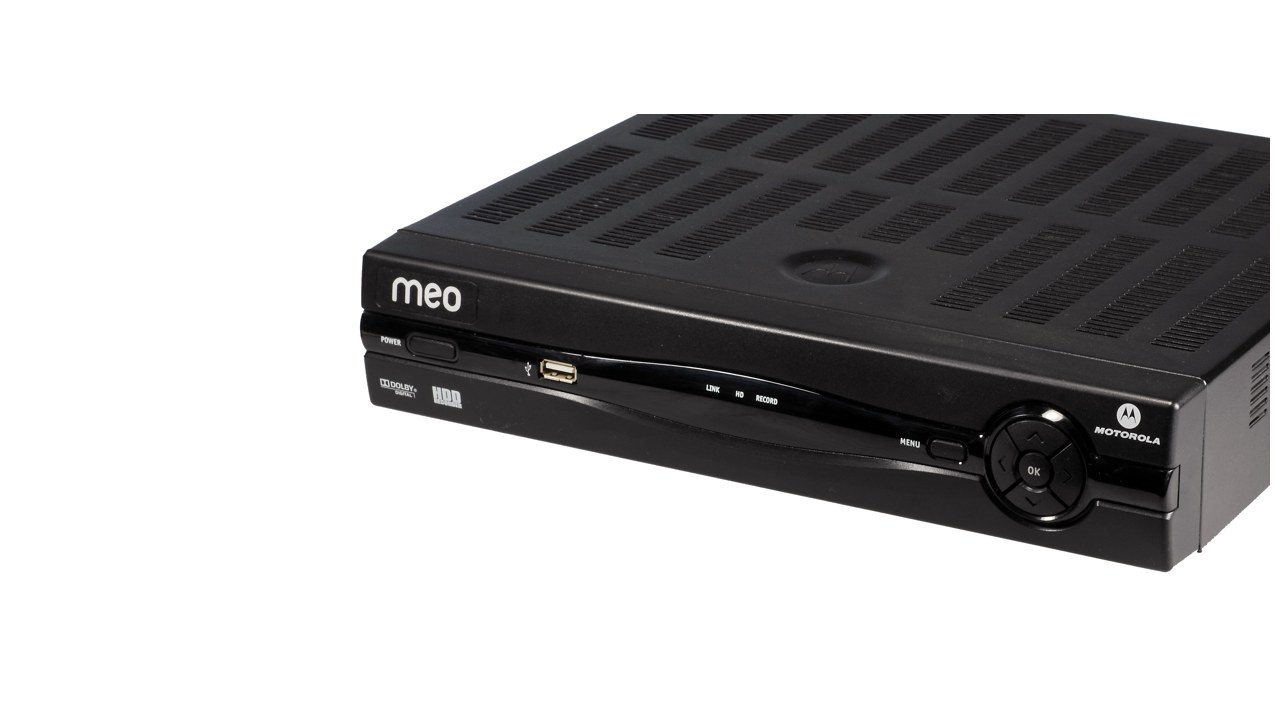
A MEO television set-top box, with the operator's wordmark on the front panel
Tech 16 September 2026

Portugal's biggest telecoms operator was knocked over three times in one night by a DDoS attack

MEO says the outages were a distributed denial-of-service attack and that no data was accessed. Under the cybersecurity regime in force since April, the operator now owes a 24-hour notification, a 72-hour update and a final report within 30 working days.

If your internet and television dropped out three separate times between Monday night and Tuesday morning, that was not a fault on the line. MEO's own technical analysis points to a distributed denial-of-service attack aimed at its infrastructure, with enough traffic thrown at it to congest the network and degrade service temporarily. The operator was precise about two things. Nobody got into the data, its own or its customers'. And the instability in BGP…

Continue reading
Dario Amodei on stage in a blue shirt and lapel microphone, gesturing with both hands during a conference session
Tech 13 September 2026

Three AI rivals agreed to slow down. The US president took a day to disagree

Dario Amodei published a 3,800-word essay on Saturday arguing the industry should pace itself, with a three-step plan. Sam Altman and Elon Musk backed it within hours. On Sunday Donald Trump called the people asking for it negative forces.

On Saturday the chief executive of Anthropic published a roughly 3,800-word essay arguing that the artificial intelligence industry should deliberately slow the rate at which it improves model capabilities. Within hours, two competitors who agree with him on almost nothing said he was right. The essay is called We Must Pace the Frontier and it sits on Dario Amodei's personal site. It sets out three steps. The first is giving outside evaluators permanent,…

Continue reading
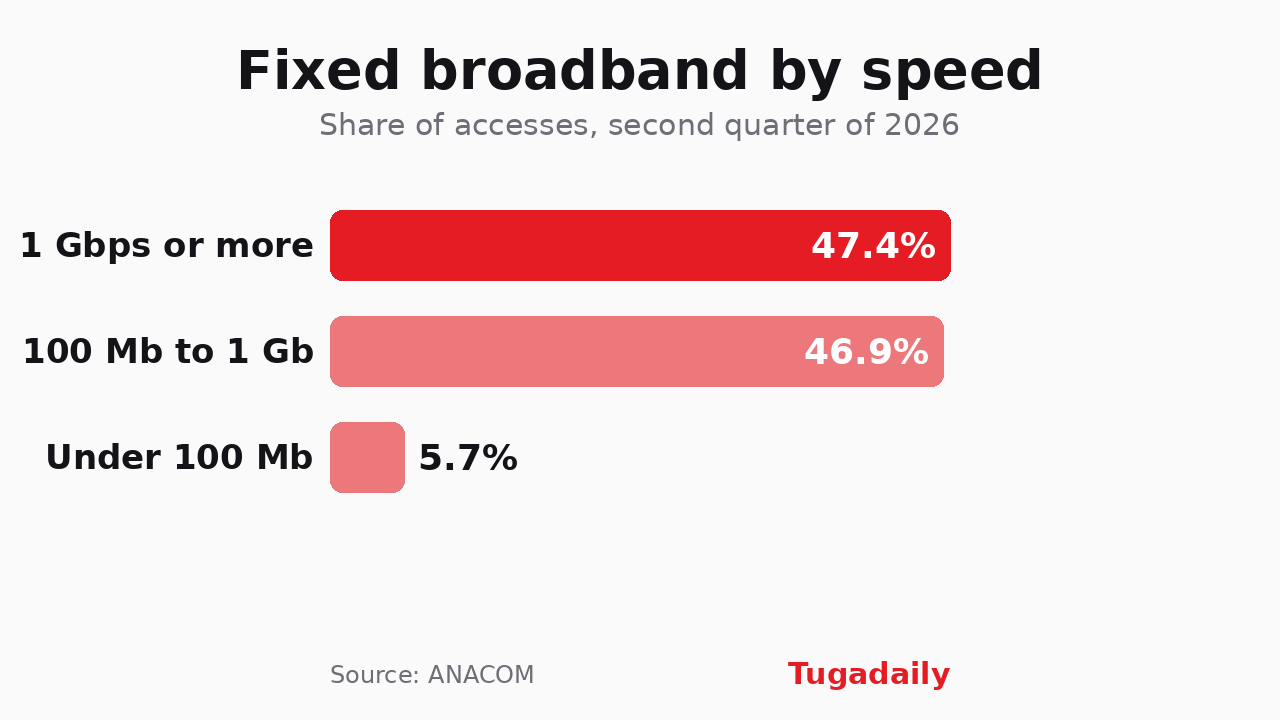
Chart showing the split of fixed broadband accesses in Portugal by speed in the second quarter of 2026
Tech 11 September 2026

What speed is home internet in Portugal? As of this quarter, mostly a gigabit

Portugal closed the second quarter of 2026 with 4.9 million fixed broadband lines. Connections at 1 Gbps or faster overtook the 100 Mbps to 1 Gbps tier for the first time.

Something quiet happened in the regulator's quarterly figures. At the end of June, fixed internet connections running at 1 Gbps or more made up 47.4% of the total, against 46.9% for those between 100 Mbps and 1 Gbps. It is the first time the top tier has come out in front. For years it was the small slice. Now it is the biggest one. Portugal ended the second quarter with 4.9 million fixed broadband accesses, 102,000 more than a year earlier, a rise of…

Continue reading
An Ariane 6 rocket lifting off from Kourou in white smoke and orange flame, framed by the towers of the launch pad
Tech 11 September 2026

Amazon just bought six more Ariane 6 flights, taking its European order to 24

The Amazon Leo contract with Arianespace grows from 18 to 24 launches through 2031, with the new flights starting in 2029 on the heavier Ariane 64. Three missions have already put 100 satellites in orbit this year.

Amazon has ordered six more launches from Arianespace, lifting the total number of contracted Ariane 6 flights for its Amazon Leo constellation from 18 to 24. The added flights begin in 2029 on the higher-capacity Ariane 64, and the programme now runs to 2031. It is the largest commercial contract in Arianespace's history, and Amazon Leo is its single biggest customer. That tells you something about where the money in European spaceflight currently sits:…

Continue reading
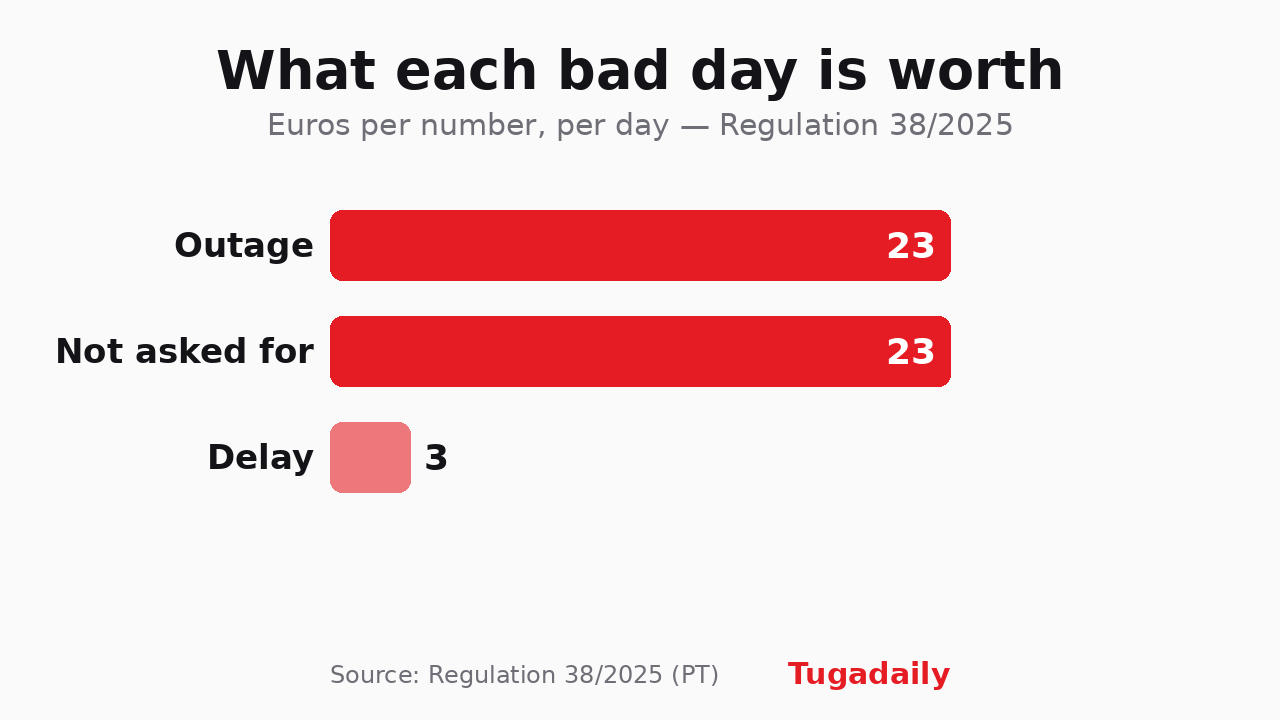
Bar chart of the daily compensation set by Portugal's Regulation 38/2025: 23 euros a day for an outage, 23 euros a day for a number ported without consent and 3 euros a day for a delay
Tech 10 September 2026

Portugal's regulator wants your new broadband provider to pay €23 for every day you are left offline

ANACOM's draft rules on switching internet providers close for comment on Friday. They hand the whole process to the incoming company and carry a €5,750 ceiling that is already law for phone numbers.

If you have ever switched broadband in Portugal, you may know the gap. The old line is cut, the new one is not up yet, and the two companies spend the week pointing at each other while you tether off your phone. Nobody is responsible, so nobody pays. ANACOM wants to close that gap. The regulator has a draft regulation on changing internet access providers out for public consultation, and comments close this Friday, 11 September. The core of it is a shift…

Continue reading
Aerial panorama of the Andøya launch site in northern Norway, its facilities set along the shore below the mountain
Tech 8 September 2026

Europe's first commercial rocket reached orbit on Saturday. The Azores spaceport is still waiting

Isar Aerospace's Spectrum lifted off from Andøya on 5 September and reached orbit around seven minutes later, deploying five CubeSats. Portugal's Santa Maria has the licence and the geography, but no flight yet.

Europe spent years saying it needed to be able to launch for itself. On Saturday it started being able to say that in the past tense. Spectrum, built by Germany's Isar Aerospace, lifted off from Andøya in northern Norway and reached orbit around seven minutes later, deploying its payloads there. It was the launcher's second flight and its first carrying satellites: five CubeSats plus a non-deployable scientific experiment. It is the first orbital flight…

Continue reading