
This is the busiest September for flu at Portugal's health centres in ten years
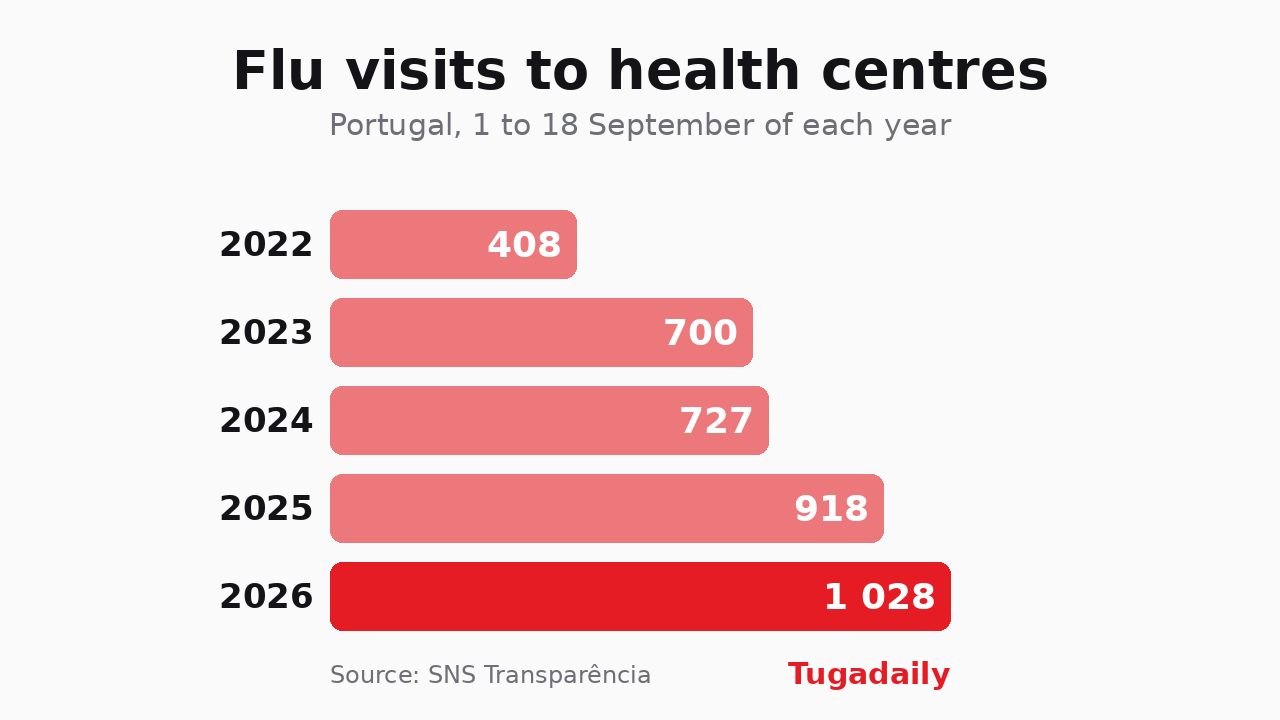
We added up the daily records the SNS has published since 2016. Between 1 and 18 September there were 1,028 flu consultations in primary care, 12% more than last year and the highest in the series. Flu season itself does not usually start until November.
Portugal’s health centres recorded 1,028 flu consultations between 1 and 18 September. That is the highest figure for that window in ten Septembers of daily records: 918 last year, 727 in 2024, 700 in 2023, and just 519 in 2019, the last autumn before the pandemic. Very nearly double.
Nobody has published this number because nobody worked it out. The data has been open for years, updated most days, sitting there waiting for someone to add it up.
How we counted
We went to the primary-care flu attendance dataset on the SNS Transparência portal, which publishes the number of flu consultations logged in each of the five health regions, day by day. The series opens on 1 November 2016 and the last loaded day is 18 September 2026. That is 18,045 rows covering 3,609 calendar days, five regions per day, with no gaps at all.
We summed the five regional figures for 1 to 18 September in each year and lined the totals up. Then we did it again from the CSV file instead of the JSON, with a different script, because a wrong number in a piece like this has nobody else to correct it. Both counts agreed.
One point of vocabulary that matters here. These are consultations, not patients. Go twice and you are counted twice. And it is flu as the doctor logged it in primary care, not flu confirmed in a laboratory, and certainly not the flu somebody rode out at home.
The rise is not national
Broken out by region, the count changes character. Lisboa e Vale do Tejo went from 258 consultations last September to 372 this year, a jump of 44%. The Algarve rose from 42 to 56, the Alentejo from 80 to 93. The North and the Centre both edged down, from 299 to 286 and from 239 to 221.
The national record, in other words, is mostly a Lisbon record. Worth holding on to before turning 1,028 into a sentence about the country.
There is a second movement underneath the first. Unscheduled consultations at health centres, the natural denominator here, fell from 411,000 to 383,000 across those same eighteen days. So flu is not only growing in absolute terms; it is taking a bigger slice of a demand that shrank. In 2017 it accounted for 0.09% of September’s unscheduled visits. This year it is running at 0.27%.
September still is not flu season
This is the part the number does not say, and it is the part worth keeping. In none of the ten seasons the series covers did the three-day average pass 300 consultations a day before 2 November. The peak almost always lands between mid-December and early January: 2,509 consultations in a single day on 3 January 2024, and 2,225 on 15 December 2025. Against that, thirty-odd cases a day in mid-September is background noise.
What 1,028 marks is the starting line, not the race. A heavier September does not guarantee a worse winter, and anyone telling you otherwise is guessing.
The seasonal vaccination campaign opens on 30 September, with the free flu jab extended to children aged 2 to 4. Between that date and the week the curve historically turns upward there are six to eight weeks, which is roughly how long a vaccine needs to be worth anything. The calendar, at least, is on the right side.
We will keep adding this up month by month, the same way we worked through six years of hospital teleconsultations. A number is only yours for as long as you keep going back for it.
Chart: Tugadaily, on SNS Transparência data