
Portugal's firefighting force drops by 2,283 people on 1 October, eleven days after a Coimbra fire needed 806
Three ignitions merged into one front on Saturday across Vila Nova de Poiares, Arganil and Góis, drawing 806 personnel, 260 vehicles and 15 aircraft. Three firefighters were lightly injured. The maximum DECIR phase ends on 30 September.
The fire that on Saturday joined Vila Nova de Poiares, Arganil and Góis into a single front has been in resolution since 00:45 on Sunday. More than 300 personnel stayed on the ground waiting for flare-ups, which is always the quiet part of these nights.
It began as three ignitions. Two broke out very close together at Sabouga, in the parish of Lavegadas in Vila Nova de Poiares, reported at 13:40; the third had been logged five minutes earlier at Murganheira, in Pombeiro da Beira, Arganil. They merged, and through the afternoon the fire ran freely towards Góis with three villages in its path. Chapinheira and Vila Nova de Ceira were declared out of danger around 23:30.
At its peak the incident held 806 personnel, 260 vehicles and 15 aircraft. Three firefighters were hurt, with light injuries; the commander of the Arganil volunteer brigade was struck by a vehicle at the scene.
Eleven days until the force changes size
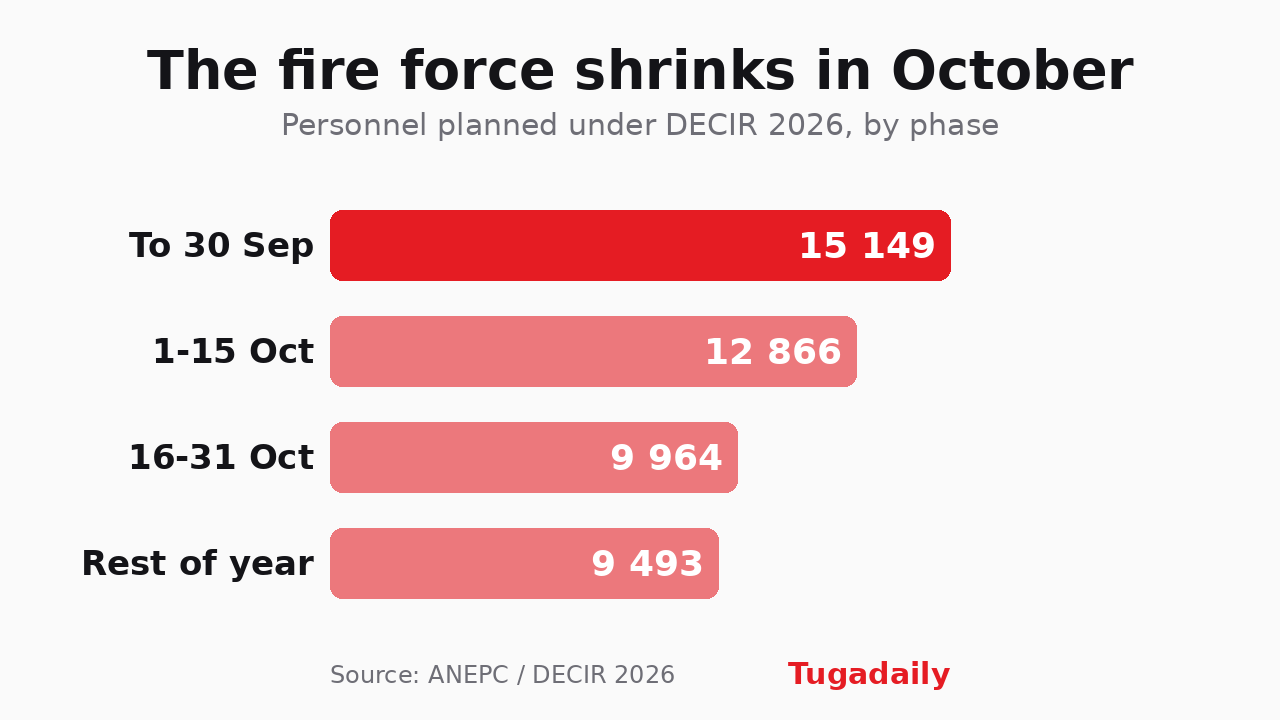
This is where the date matters. Portugal does not fight fires with a fixed headcount: National Operational Directive no. 2 splits the year into phases, and the heaviest of them, phase Delta, runs from 1 July to 30 September with 15,149 personnel, 3,463 vehicles and 50 aircraft.
On 1 October the country moves to phase Charlie: 12,866 personnel and 2,857 vehicles. That is 2,283 fewer people and 606 fewer vehicles, overnight. On 16 October it steps down again, to 9,964, and stays there until the following summer.
Set side by side, the two figures say the same thing twice. A fire like Saturday’s absorbed a little over 5% of the entire national force at its strongest, and close to a third of the 50 contracted aircraft. Eleven days from now, the same fire would meet a country with 2,283 fewer people to give it.
The calendar and the weather do not always agree
None of this is a planning error. The phases follow average meteorological risk, and October is, on average, far wetter than August. The trouble is that an average is not a promise. September keeps producing large fires well after public attention has moved on, and this year Portugal has burnt less land than in 2025 but had more fires — more starts, each of them smaller, which also means more days with the machine running.
Keep the date in mind even if autumn arrives on schedule. Back in August, three fires in the north burnt 5,200 hectares and left an Arouca firefighter in intensive care. The part of the year when the forest burns does not end because a directive says so. It ends when it rains.
Until then the critical period still applies, with the rules that come with it: no agricultural burning, no open fires, no machinery working in scrub during the hottest hours.
Chart: Tugadaily, on ANEPC's National Operational Directive no. 2