
Portuguese 15-year-olds post their worst-ever PISA reading result
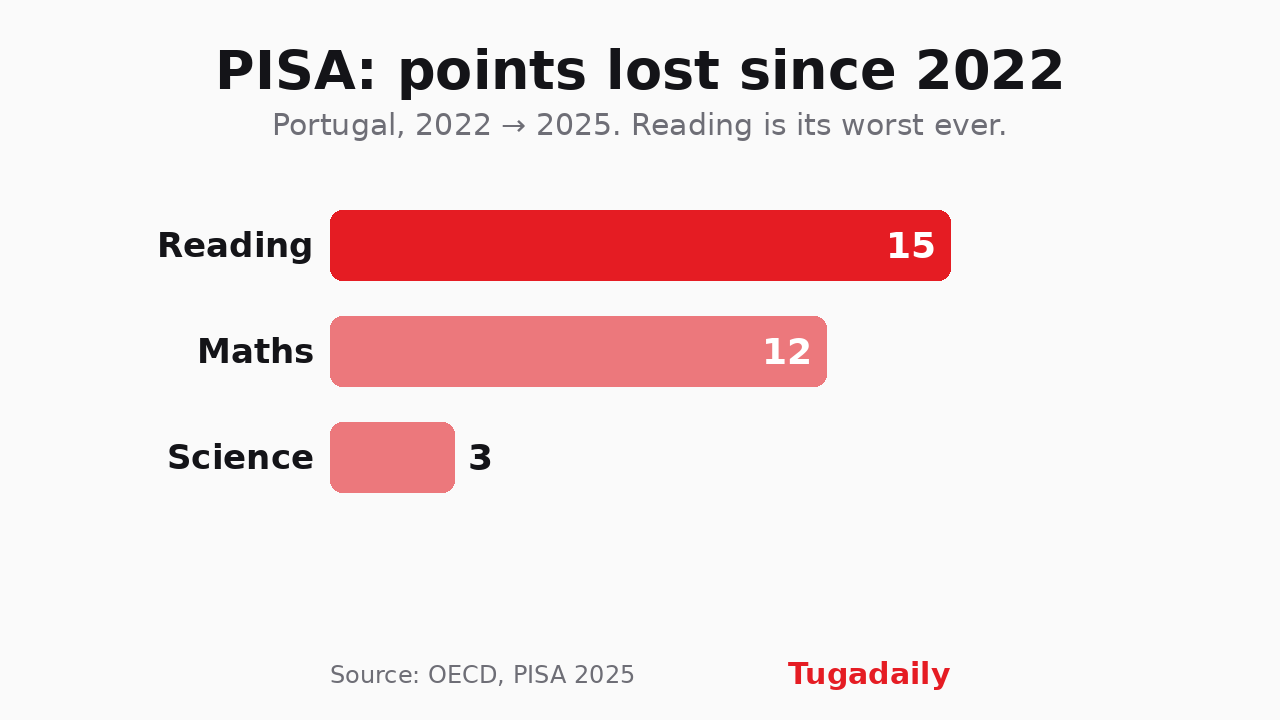
Portugal scored 462 in reading and 460 in maths, down 15 and 12 points since 2022, with science on 482. That is roughly where the country stood in 2006.
The PISA 2025 results landed on Tuesday, and Portugal’s numbers are grim in all three subjects at once. Fifteen-year-olds here scored 460 in maths, 462 in reading and 482 in science. Those are close to what the country was recording in 2006, before two decades of steady gains that have now been handed back.
Set against 2022, the fall is 15 points in reading and 12 in maths. Science held up better, slipping three.
Reading is the one that stings. It is Portugal’s lowest score since the country started sitting these tests in 2000. Maths has drifted back to roughly its 2003 level, and the cumulative drop since 2018 now runs to 32 points.
Middle of the table, wrong direction
Portugal is still sitting almost exactly on the OECD average, which came in at 463 for maths, 461 for reading and 482 for science. Ranked against the field, that puts the country 30th in maths, 26th in reading and 29th in science out of 91 participating countries and economies.
So the position is unremarkable. The trajectory is not. Portugal used to be one of the systems the OECD pointed to when it wanted an example of sustained improvement, and that story has now been unwritten. The 2025 round was sat by 6,945 students across 225 Portuguese schools, part of a global sample of 760,000, and the methodology sits with the OECD’s PISA programme.
What the government said
Secretary of State Alexandre Homem Cristo called the results historically negative and said they were causing concern inside the education ministry. He also argued that a test taken in 2025 does not measure this government’s period in office directly, while accepting that the government is responsible for finding answers.
That is both a fair point and a convenient one. The students tested went through the years that matter before this administration, and education policy takes a long time to show up in any indicator. It is still cold comfort to anyone who is fifteen right now.
Teaching unions have pointed instead at unfilled posts and the churn of staff inside schools, an argument that connects to the row over placement incentives and the €750 supplement that left the whole Alentejo outside the map. Others want a return to the policies of the early 2000s, which is precisely when the Portuguese lines were climbing.
PISA runs every three years, so the next reading arrives in 2028. That is when we find out whether 2025 was a dip or a new floor. In the meantime, the INE’s vital statistics show a school-age cohort that keeps shrinking, which makes every pupil count for more and every policy choice heavier.
Chart: Tugadaily · Data: OECD, PISA 2025