
Did cutting 6,765 short-term lets bring Lisbon rents down? The numbers say no
The city cancelled about 40% of its short-term rental registrations in February, taking active listings from nearly 20,000 to 11,779. In the quarter that covers the cut, median rent on new contracts in Lisbon rose 8.2% to €17.42 per square metre, the highest in the country.
For years the standard answer to Lisbon’s housing costs was Airbnb. Take the short-term lets out of the market, the argument ran, and the flats come back to ordinary tenants. Lisbon has now done exactly that, at scale, and there are finally numbers showing what happened next.
On 1 February the city council finished an administrative clean-up of its register and cancelled 6,765 short-term rental licences, roughly 40% of the city’s total. Most were ghost licences, held by owners who never filed proof of civil liability insurance and in many cases never took a guest. Active registrations fell from close to 20,000 to 11,779. Lisbon was the first municipality in the country to complete the exercise.
What rents did next
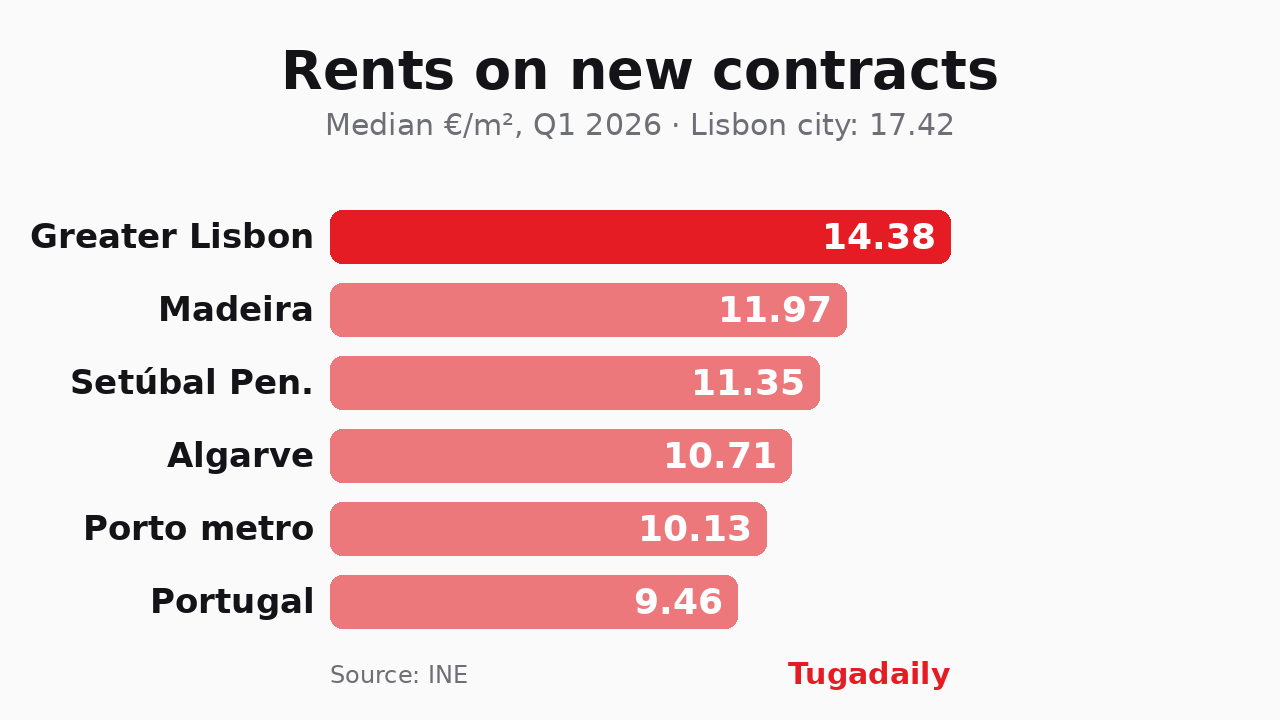
Not what anyone promised. INE’s figures for the first quarter of 2026 — the quarter that spans the cancellations — put the median rent on new contracts in Lisbon at €17.42 per square metre. That is the highest of all 24 municipalities with more than 100,000 residents, and it is 8.2% up on a year earlier.
That 8.2% deserves a fair hearing, because it is the one figure in the set that supports the case at all. It came in below the national rise of 9.1%. Lisbon went up by less than the country did. It still went up.
Everywhere else the picture is the same. Median rents rose in every single sub-region, mainland and islands, without exception. Greater Lisbon leads at €14.38 per square metre, ahead of Madeira, the Setúbal peninsula, the Algarve and the Porto metro area. The national median sits at €9.46 across 39,395 new contracts.
Why removing the listings was not enough
The simplest explanation is the least satisfying one. Cancelling 6,765 registrations does not release 6,765 flats. A large share of them were paperwork — dormant licences with no guests behind them and therefore no empty home behind them either. Striking off a registration nobody was using returns nothing to the market.
The head of ALEP, the sector’s association, keeps pointing out that there is not one neighbourhood where prices came down, not even in the containment zones where the squeeze on short-term lets was hardest. That is an interested party talking. The INE data does not contradict him.
What survives is the reading housing economists have offered for years, and this episode strengthens it: Lisbon’s problem is the total quantity of housing, not how it is divided between visitors and residents. We have written before that there are fewer and fewer homes to rent in Portugal, and Lisbon fits the pattern — the slices moved, the pie did not.
None of which makes short-term rental rules pointless. They do things to noise, to who lives on a street, to whole buildings handed over to keyboxes. The narrower and more useful claim is this one: do not buy them as price policy, because as price policy they are not working. The European debate now coming down the track, for that matter, is no longer only about short-term lets.
When you can check this
On 29 September. That is the date of INE’s next release, covering the second quarter — the first complete quarter after the 6,765 registrations vanished. If the short-term rental theory is right about any of this, that is where it would have to show up.
Chart: Tugadaily · Data: INE